
A Montessori classroom’s setup is its deliberately prepared environment: the arrangement of furniture, learning materials, routines, and choices that helps children act and learn with growing independence. Often described as a “silent teacher,” this environment communicates where things belong, what children can do, and how they can care for shared space without constant adult direction. Montessori’s own account of the method emphasizes an environment adapted to the child, while research reviews report promising academic and social-emotional outcomes for Montessori education, though results vary by study and implementation. The room’s scale, accessible materials, purposeful order, and freedom within clear limits work together to make that teaching visible.
The prepared environment defines the silent teacher
“Prepared environment” is the Montessori term for a classroom intentionally organized to support children’s development. The American Montessori Society describes it as a setting designed to meet children’s needs for independence, movement, concentration, and meaningful work. It is not simply an attractive room: its layout and contents are selected so children can make purposeful choices, use materials, and restore them with minimal adult intervention.
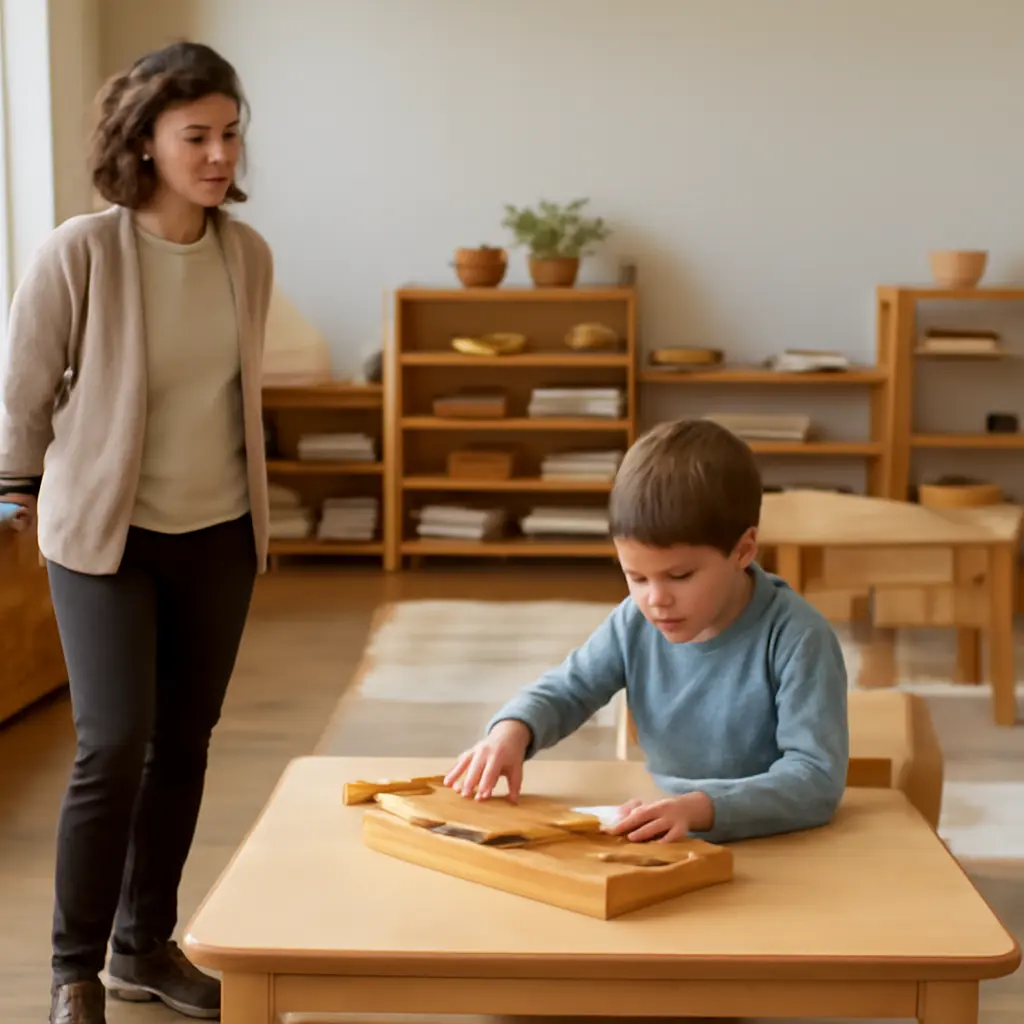
The phrase “silent teacher” captures the environment’s indirect guidance. A low shelf suggests that materials are for children to select; a defined work area supports concentration; a complete activity arranged in sequence signals how it can be used. The room does not replace a trained teacher. Rather, its design reinforces lessons and routines, allowing the adult to observe, present materials, and offer help when needed.
This design matters because classroom organization can shape access and participation. The National Center for Montessori in the Public Sector reports that Montessori classrooms commonly group children across three-year age spans, such as ages three to six or six to nine. That structure can enable younger children to learn by observing older peers and older children to consolidate learning by demonstrating it. It also makes carefully arranged materials and clear classroom routines especially important.
Order and accessibility
Order means that materials have predictable places and are presented in a clear, usable sequence. Accessibility means children can reach and manage those materials themselves. Together, these features reduce unnecessary dependence on adults: a child can choose an activity, carry it to a work space, and return it when finished. Accessible storage should still be safe, uncluttered, and appropriate to the child’s age and abilities.
Freedom within limits
Montessori choice is not unrestricted activity. Children choose from lessons and materials introduced by the teacher, while community expectations protect safety, respect, and other people’s concentration. A work rug or table can mark a child’s work area; waiting for a material and returning it to its place make choice compatible with shared classroom life.
The silent teacher guides movement, choice, and concentration
The prepared environment teaches through repeated, practical cues rather than constant verbal correction. Its effects depend on how physical space, materials, and daily routines fit together. When those elements are coherent, children can recognize the next step in an activity and participate more independently.
Child-sized furniture and purposeful movement
Child-sized tables, chairs, shelves, sinks, and tools make ordinary classroom actions achievable. Clear pathways allow children to move materials without disrupting others, while defined spaces for individual or group work help them understand where an activity belongs. The aim is not to keep children still: purposeful movement is part of Montessori work, provided it respects other learners and the room’s routines.
Materials that invite hands-on learning
Montessori materials are designed to make ideas concrete and to encourage active exploration. In many classic materials, a built-in feature—often called a control of error—helps a child notice when something does not fit or is incomplete. For example, a puzzle piece that will not settle into the wrong opening offers feedback without requiring an adult to announce every mistake. Such feedback can support persistence, but it does not mean that every material teaches without explanation; teachers demonstrate appropriate use and observe the child’s response.
Materials are commonly arranged from simpler to more complex and presented in complete sets. This arrangement helps children see what is available and gives the teacher a practical way to introduce work in a developmental sequence. A shelf that is too crowded or contains incomplete activities weakens that message, so teachers regularly inspect and refresh the selection.
Daily routines and care of the classroom
Care-of-environment activities—such as wiping a table, watering a plant, or returning a tray—make classroom responsibility concrete. A predictable routine turns those actions into part of the work cycle rather than a special reminder from an adult. These tasks also connect practical life, coordination, sequencing, and community participation.
The silent teacher supports learning, with evidence that requires context
Classroom design is one component of Montessori education, not a stand-alone intervention. Outcomes also depend on teacher preparation, curriculum, time in the program, student characteristics, and how faithfully the approach is implemented. Research can therefore inform decisions without proving that any single shelf, material, or room arrangement causes a particular result.
A 2017 systematic review and meta-analysis by Angeline Lillard and colleagues, published in npj Science of Learning, found that Montessori education was associated with positive academic and nonacademic outcomes in the studies reviewed. The authors also noted limits in the research base, including variation in study quality and the difficulty of separating Montessori’s multiple features. This is useful context: the prepared environment is a central part of the method, but published outcome findings should not be attributed to room setup alone.
Public-school implementation illustrates how the environment must adapt without losing its purpose. The National Center for Montessori in the Public Sector describes Montessori programs operating in public settings, where educators work within local requirements while maintaining features such as mixed-age classrooms, hands-on materials, and student choice. A classroom’s silent cues can still function in a shared or resource-constrained setting, but schools need to plan for storage, accessibility, safety, and the time required to maintain materials.
What a well-prepared room can make observable
Rather than judging the environment by appearance alone, educators can look for evidence of how children use it. Useful indicators include whether children can locate and return materials, move safely, begin familiar work with appropriate independence, and sustain attention without frequent interruption. These observations can guide practical adjustments, such as widening a walkway, reducing shelf clutter, or placing a frequently used material within easier reach.
- Check whether furniture and tools fit the children who use them.
- Arrange complete materials in a visible, logical sequence.
- Keep paths clear and provide defined spaces for different kinds of work.
- Teach routines explicitly, then make the room reinforce those routines.
- Observe children’s use of the space and revise the setup when it creates barriers.
Conclusion: the silent teacher makes independence tangible
The Montessori prepared environment is a purposeful system in which order, accessible design, hands-on materials, and shared routines guide children’s choices and movement. Its “silent teacher” role is not to replace human teaching, but to make expectations and opportunities easier to see and act upon. Research reviews offer encouraging evidence about Montessori education overall while cautioning that results reflect a broader educational approach, not classroom setup in isolation.
Educators and families can learn from this principle by asking a practical question: does the space help children participate, or does it make them wait for an adult? Observe how children move through a room, identify points of friction, and make one thoughtful adjustment at a time. For further reading, consult Montessori’s foundational writing, guidance from the American Montessori Society, and research reviews that explain both findings and limitations.
Sources: American Montessori Society, “The Montessori Classroom,” https://amshq.org/About-Montessori/Inside-the-Montessori-Classroom; Maria Montessori, The Montessori Method, 1912, https://archive.org/details/montessorimethod00mont; Angeline S. Lillard et al., “Montessori Preschool Elevates and Equalizes Child Outcomes: A Longitudinal Study,” npj Science of Learning, 2017, https://www.nature.com/articles/s41539-017-0012-7; National Center for Montessori in the Public Sector, “Montessori Public,” https://www.public-montessori.org/
Related Posts
Montessori pacing rarely looks like the pressure cooker of a standard classroom
Montessori education is a child-centered approach in which learners work…

A Professional Guide to Designing an Effective Montessori Classroom Environment
Design Principles of an Effective Montessori Classroom Environment An effective…

Struggling to Teach Early Math How Montessori Math Curriculum Makes Numbers Click
Montessori Math Curriculum and Early Math Learning Challenges Struggling to…