
Montessori education is a child-centered approach in which students learn through purposeful activity, carefully prepared classrooms, and guidance from trained teachers. For parents concerned that Montessori means “no rules,” the key distinction is that it offers freedom within clear limits—not an absence of structure. Children typically follow predictable routines, choose from teacher-presented work, and learn to care for themselves and their shared classroom. Research suggests Montessori can support academic and social-emotional development, though outcomes vary by program and study; understanding the daily structure, age groupings, and school-quality indicators can help families judge whether a particular school fits their child.
Montessori classroom structure balances choice with boundaries
The American Montessori Society (AMS) describes Montessori as an educational approach based on self-directed activity, hands-on learning, and collaborative play. In a well-implemented classroom, children make choices from a purposeful set of activities while adults establish expectations for safe, respectful use of materials. The freedom is real, but it operates inside a designed environment and a shared social framework.
This distinction matters because “structure” can mean different things: a tightly teacher-led sequence for the whole class, or consistent routines and clear expectations that allow children to work independently. Montessori typically emphasizes the latter. A classroom may look quieter or less uniform than a conventional lesson, yet its routines—arrival, work time, transitions, material care, and cleanup—are part of its structure.
Prepared environments define where choice happens
A prepared environment is a classroom intentionally organized for children’s age, development, and independence. Materials are arranged accessibly, usually on low shelves, and each activity has a specific purpose. Teachers introduce materials and show children how to use and return them. A student may choose among available lessons, but does not have unlimited access to every activity at any moment.
The environment itself creates practical boundaries: a child generally takes one activity at a time, uses it in the intended way, and returns it before choosing another. If a child is not ready for a material, the teacher can demonstrate it again or offer a different task. This makes choice a guided skill that develops over time, rather than a demand that a young child manage everything independently from day one.
Freedom within limits includes social expectations
“Freedom within limits” is a common Montessori principle: children can make meaningful choices as long as their actions do not harm themselves, others, or the learning environment. Typical expectations include using materials respectfully, allowing classmates to concentrate, walking indoors, and waiting for a turn when an activity is in use.
Teachers support these expectations through modeling, brief lessons, reminders, and calm intervention. A Montessori classroom is not meant to leave disruptive behavior unaddressed. The adult’s role is to guide behavior while helping children gradually develop self-control and consideration for others, rather than relying only on rewards or punishments.
Montessori daily routines provide predictable structure
A Montessori day often includes a substantial uninterrupted work period, during which children select and complete activities while teachers observe, present lessons, and offer individual help. AMS identifies a three-hour work period as a feature of many full Montessori programs for children ages three to six. Schedules differ by school, age level, and local requirements, so parents should ask how a specific program structures its day.
The long work period is not simply unmonitored free time. It gives children a chance to settle into tasks, repeat an activity, and practice sustained attention. Teachers track progress and may guide a child toward a lesson in language, mathematics, practical life, or sensory learning. Group lessons, outdoor time, meals, and transitions also form part of the daily routine.
Mixed-age classrooms build continuity and peer learning
Many Montessori classrooms group children across a multi-year age span, commonly in three-year cycles such as ages three to six or six to nine. Younger students can observe more experienced classmates, while older children have opportunities to explain routines and serve as role models. The teacher plans lessons for individuals or small groups rather than expecting every child to complete the same task at the same time.
Mixed-age grouping also means that children may not move through a single, identical sequence at the same pace. Progress is often documented through observations, work records, and teacher assessments. Parents who want a clear picture of learning should ask how the school communicates individual progress and how it identifies children who need additional support or challenge.
Materials and teacher guidance make independence teachable
Montessori materials are designed to make concepts tangible and to encourage active practice. A child might use beads to explore quantity, movable letters to build words, or practical-life tools to practice pouring and fastening. Many materials include a way for the child to notice or correct an error, while the teacher observes and decides when to introduce the next step.
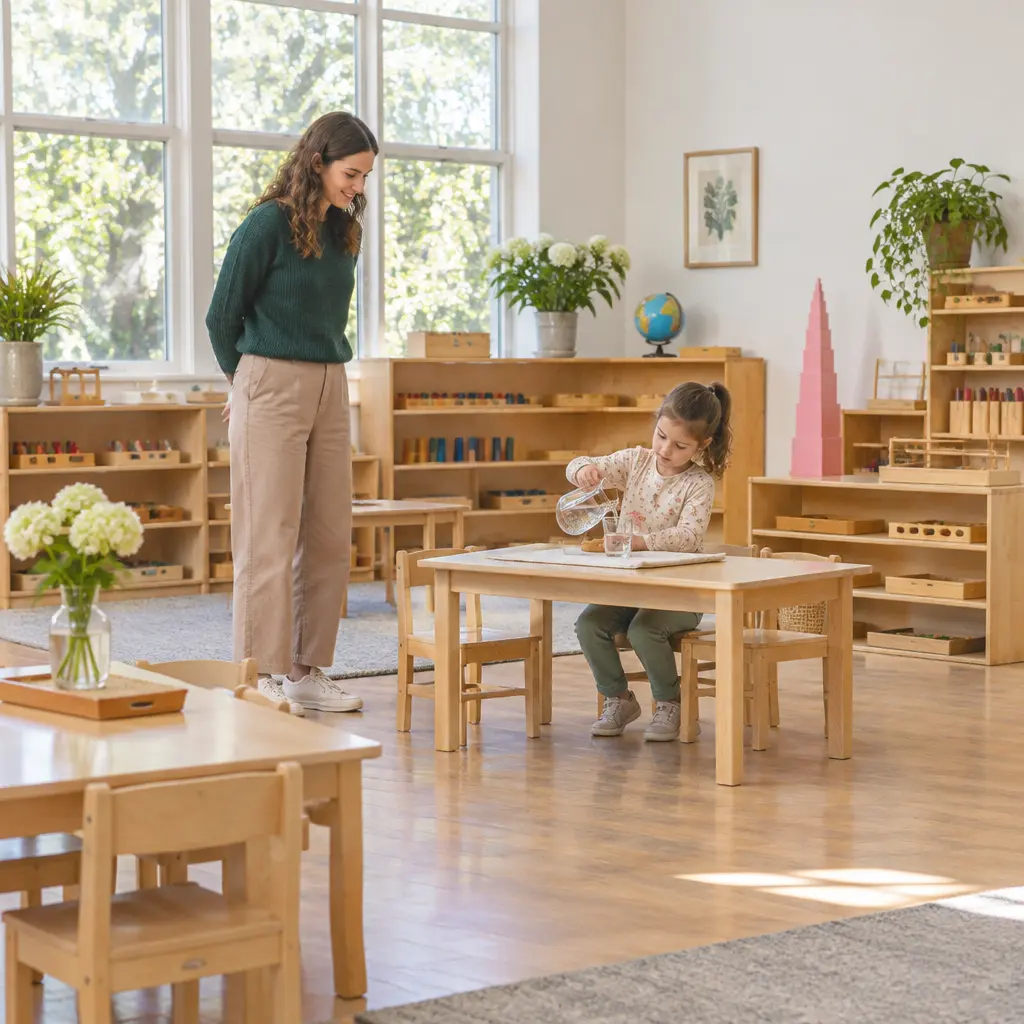
Independence does not mean adults withdraw. The teacher prepares the room, presents lessons, monitors development, and intervenes when safety, conflict, or learning needs require it. Parents can ask to see a typical lesson and learn how teachers respond when a child wanders, becomes frustrated, or repeatedly chooses an activity that is too easy.
Montessori outcomes are promising but depend on implementation
Research offers encouraging evidence, but it does not prove that every school using the Montessori name produces the same results. A 2017 study in the journal Frontiers in Psychology followed children attending a public Montessori preschool lottery program in the United States. By the end of kindergarten, children offered a Montessori place showed stronger outcomes in areas including academic achievement, executive function, and social understanding than children who did not receive an offer. Because the study evaluated a particular program and population, its findings should not be treated as a guarantee for every school.
A 2023 systematic review and meta-analysis published in Campbell Systematic Reviews examined Montessori education research and reported positive average effects across several academic and nonacademic outcomes. The authors also noted limits in the available evidence, including variation in study quality and in how Montessori implementation was defined. For parents, the practical conclusion is to consider research as context—not a substitute for evaluating the classroom, teacher preparation, and child-school fit.
School quality is more than the Montessori label
Schools may use Montessori materials or terminology without following all the features of a Montessori program. AMS and the Association Montessori Internationale (AMI) offer school and teacher-credential information that can help families understand program standards. Accreditation or affiliation can be a useful indicator, but parents should still ask what it means in practice and whether the classroom matches the school’s description.
Useful questions include whether teachers hold Montessori credentials for the age level they teach, how long children have a continuous work period, how classrooms are grouped, and how academic progress is assessed. Parents can also ask how the school handles conflict, supports children with disabilities or learning differences, and communicates with families. A visit during an ordinary school day is often more informative than a polished presentation.
A classroom visit can reveal the actual level of structure
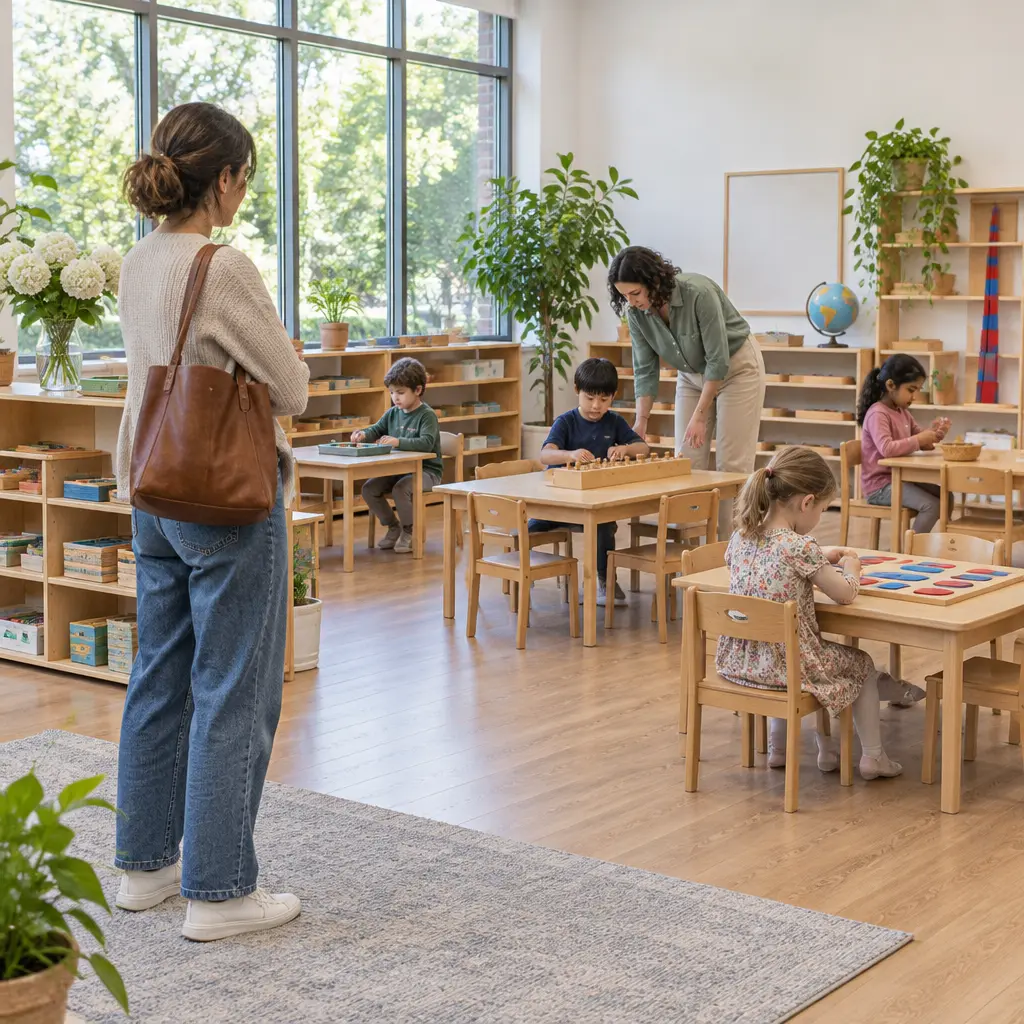
During a visit, look for children who know where materials belong, teachers who give clear and respectful guidance, and routines that help students transition without confusion. Notice whether children can concentrate, whether the room feels safe, and whether adults respond when a child needs help. Calm activity is not the only sign of quality; what matters is whether the environment is purposeful, attentive, and developmentally appropriate.
Ask the school to describe a typical day, including arrival, work time, meals, outdoor play, and transitions. If your child benefits from explicit directions or predictable schedules, ask how teachers provide those supports. Montessori practice can include visual schedules, advance warnings, individual check-ins, and other accommodations, but the details depend on the school and the child.
Montessori can suit families seeking guided independence
Montessori may appeal to families who value hands-on learning, steady routines, choice among purposeful tasks, and opportunities to build independence. It may feel less familiar to parents who expect whole-class instruction for much of the day, frequent grades, or identical assignments for all children. Neither preference is inherently wrong; the important question is whether the school’s approach meets the child’s educational and emotional needs.
Families should compare actual classrooms rather than relying on broad assumptions about Montessori. Some children thrive with the autonomy and sustained work time, while others may need more direct prompting or a different pace of instruction. A thoughtful school will be able to explain how it adapts its approach and how parents and teachers work together when a child is struggling.
Conclusion: Montessori structure supports choice, responsibility, and learning
Montessori education is not structure-free. Its prepared environment, consistent routines, clear social limits, teacher-led lessons, and carefully chosen materials create a framework in which children practice making decisions and managing their work. Mixed-age classrooms and uninterrupted work periods are common features, while research points to promising outcomes alongside important limits in the evidence.
For parents worried about losing structure, the most useful next step is to observe a school and ask specific questions about its daily schedule, teacher training, behavior guidance, and progress reporting. Compare what you see with what your child needs, and use school visits and reliable Montessori organizations as further reading. The best choice is not the label alone, but a safe, responsive learning environment where your child can grow.
Sources: American Montessori Society, “What Is Montessori Education?”, https://amshq.org/About-Montessori/What-Is-Montessori; American Montessori Society, “The Montessori Classroom,” https://amshq.org/About-Montessori/Inside-the-Montessori-Classroom; Lillard, Angeline S. and Nicole Else-Quest, “Evaluating Montessori Education,” Frontiers in Psychology, 2017, https://doi.org/10.3389/fpsyg.2017.01783; Randolph, Jennifer et al., “Montessori education’s impact on academic and nonacademic outcomes: A systematic review,” Campbell Systematic Reviews, 2023, https://doi.org/10.1002/cl2.1330; Association Montessori Internationale, “Montessori Schools,” https://montessori-ami.org/schools.
Related Posts

Tired of Punishments That Don’t Work How Montessori vs Traditional Discipline Changes Behavior for Good
Montessori Discipline Approach: Transforming Child Behavior for Lasting Change The…
Choosing a Montessori School Questions About Tuition, Authenticity, and Teacher Turnover
Montessori school choice comes down to more than a school’s…
Montessori Teaching Methods for Teachers Who Find Waiting to Intervene Difficult
Montessori teaching methods help teachers support children’s independence by observing…