
Montessori teaching methods help teachers support children’s independence by observing first and intervening with purpose rather than reflexively taking over. The approach is grounded in prepared environments, purposeful activity, and respect for children’s capacity to work; it does not mean leaving a child unsupported or ignoring safety. For teachers who find waiting difficult, practical tools include observation, purposeful pauses, clear intervention thresholds, and brief, least-intrusive guidance. These strategies align with Montessori principles while drawing on broader evidence about self-regulation and adult-child interaction; the evidence supports careful practice, not a guarantee that every child or classroom will respond the same way.
Why Montessori teachers wait before intervening
Montessori education is an approach in which adults prepare an environment and guide children’s learning while making room for self-directed activity. The American Montessori Society describes the teacher as an observer and guide who introduces materials and supports development rather than directing every moment. Waiting, in this context, is an intentional teaching decision: it gives a child time to notice a problem, choose a strategy, repeat an action, or ask for help.
Waiting is not a universal rule. A teacher should intervene immediately when someone faces danger, when a child is distressed or unable to proceed, or when another person’s rights or learning are being disrupted. In less urgent moments, a short pause can preserve the child’s opportunity to act. This distinction matters in busy classrooms, where an adult’s impulse to help can unintentionally interrupt concentration or communicate that a child cannot manage a challenge.
The broader evidence is encouraging but should be interpreted carefully. A 2017 systematic review and meta-analysis by Angeline Lillard and colleagues reported positive academic and nonacademic outcomes across studies of Montessori education, while also noting limitations in the available research and variation in study quality. That research concerns Montessori programs overall; it does not prove that waiting alone causes better outcomes. It does, however, support taking Montessori’s integrated practices seriously rather than treating observation as mere inaction.
Observation and purposeful waiting in Montessori teaching
Observation is the disciplined process of attending to what a child is doing, what the environment makes possible, and whether support is needed. In Montessori practice, it helps the teacher decide whether to wait, adjust the environment, offer a lesson, or intervene. The key distinction is between passive delay and purposeful waiting: purposeful waiting has a clear reason, a time-limited check, and a plan for what the adult will do if the child needs support.
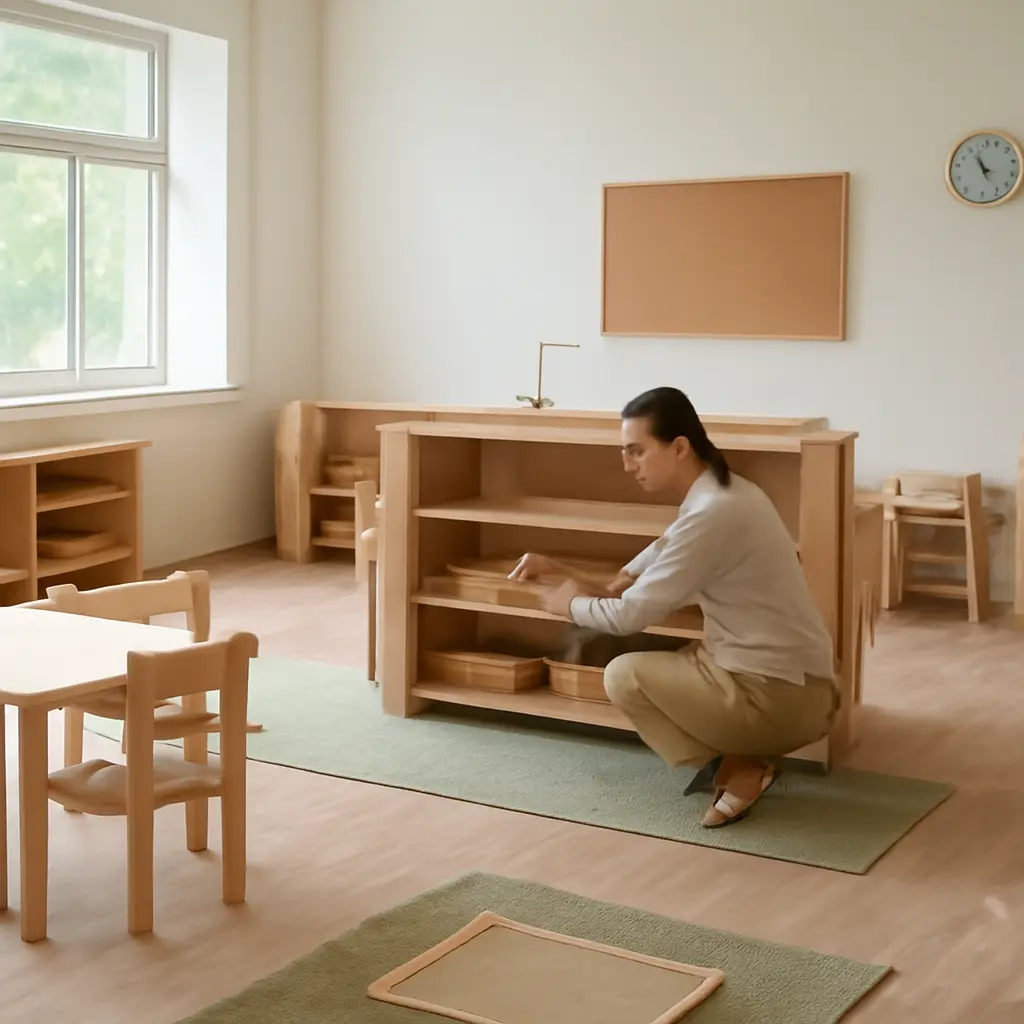
The National Center for Montessori in the Public Sector describes Montessori classrooms as organized around prepared environments, uninterrupted work, and teachers who observe and guide. These elements work together. Waiting makes little sense if materials are inaccessible, the task has not been demonstrated, or the child is being asked to work beyond their current ability. Before holding back, teachers can check whether the activity is appropriate and whether the child has had a fair chance to learn it.
Observe the child, not just the task
Observation means looking for evidence of the child’s intention and effort: Are they repeating a movement? Looking between the material and a possible solution? Trying a different grip? Seeking a peer’s help? A child who is actively experimenting may benefit from time. A child who has stopped, appears overwhelmed, or is repeatedly making the same unsuccessful move may need a small cue or a fresh lesson.
Teachers can make observation more reliable by recording brief, neutral notes. For example: “Tried the pitcher with two hands; paused; repositioned the cup; poured without help” is more useful than “Was careless.” Notes help distinguish a temporary difficulty from a recurring barrier and reduce the chance that an adult’s assumptions will determine the response.
Use an intentional pause
An intentional pause is a brief wait that allows a child to respond before the adult acts. There is no evidence-based universal number of seconds that fits every age, task, or child. Instead, teachers can pause long enough to see whether the child is still engaged, then reassess. A calm facial expression, relaxed posture, and quiet presence can communicate availability without taking over.
For a teacher who feels compelled to step in, a private routine can help: silently count, take one breath, and ask, “Is this unsafe, distressing, or blocking the child’s access to learning?” If not, observe one more attempt. This practice is not a test of patience for its own sake; it is a way to replace reflex with a deliberate instructional choice.
Intervention methods that preserve child agency
When support is needed, Montessori-aligned intervention aims to be proportionate: provide the least assistance that addresses the need, then return the activity to the child. The adult can move from observation to a quiet cue, a question, a demonstration, or direct help depending on the situation. This graduated approach connects purposeful waiting with responsive teaching rather than treating them as opposites.
Offer a cue before taking over
A cue is a small prompt that draws attention to a useful feature without solving the whole problem. A teacher might ask, “What could make the bowl steadier?” or say, “Look at where the water is going.” The child retains the work of deciding and acting. Too many questions, however, can become another form of interruption; one concise cue followed by another pause is often more respectful than a stream of hints.
This graduated assistance is consistent with scaffolding in educational practice: support is adjusted to the learner’s current need and reduced as competence grows. Scaffolding is a broader teaching concept, not a uniquely Montessori technique, but it clarifies why helpful guidance should enable the child’s next step rather than replace the child’s effort.
Re-present the lesson when the obstacle is a skill gap
A presentation is a deliberate demonstration of how to use a material or complete a sequence. If a child cannot proceed because the necessary skill has not been taught or remembered, repeated waiting is unlikely to help. The teacher can offer a brief re-presentation at a suitable moment, showing the movements slowly and clearly, then invite the child to try. The adult should avoid correcting every small variation when the child’s approach is safe and purposeful.
For instance, if a child repeatedly spills while transferring beans with a spoon, the teacher might first check the spoon’s size and the child’s posture. If the setup is appropriate, the adult can demonstrate how to hold the spoon and move it steadily, then step back. This example illustrates a general principle: adjust the environment or teach the missing skill before concluding that a child needs constant assistance.
Intervene directly for safety, distress, or harm
Direct intervention is appropriate when waiting could expose a child or peer to harm, when a child is significantly distressed, or when behavior is preventing others from participating. The teacher should act promptly, use clear and calm language, and explain the limit in terms children can understand. “I won’t let you throw the work; I’m moving it while we keep everyone safe” is more informative than a vague reprimand.
Respect for independence does not remove the adult’s responsibility to maintain a safe, inclusive classroom. If a child repeatedly cannot access an activity, the response should include examining barriers such as material design, sensory demands, language needs, or disability-related accommodations. Observation is most useful when it leads to appropriate support, not when it becomes a reason to withhold it.
Practical routines for teachers who find waiting difficult
Teachers often intervene quickly because they want to prevent frustration, keep the room moving, or avoid mess. A practical routine makes the desired response easier under pressure. The goal is not to suppress care, but to channel it into observation, thoughtful environmental preparation, and timely assistance.
Use a simple decision check
Before stepping in, ask three questions: Is anyone unsafe? Is the child showing distress or asking for help? Is the activity unavailable because of a barrier I can remove? If the answer is no, wait briefly and observe. If the answer is yes, choose the smallest effective response. This checklist helps teachers distinguish a child’s productive struggle from a situation that requires adult action.
Prepare the environment to reduce unnecessary rescue
A prepared environment includes materials that are accessible, complete, appropriately sized, and within the child’s current abilities. Clear workspaces, reachable tools, and predictable routines can prevent avoidable frustration. When a child repeatedly asks for help with the same step, the teacher can ask whether the setup—not the child—needs to change.
This is also an inclusion practice. A handle, visual sequence, adapted tool, or quieter work area may allow a child to participate more independently. The right adjustment depends on the child and should be informed by family knowledge and, where appropriate, specialists. Independence does not mean doing everything without assistance; it means having meaningful access and agency.
Reflect with colleagues and families
Brief reflection helps teachers identify patterns in their own intervention habits. After a work period, consider: What did I interrupt? What did the child manage independently? When did waiting help, and when did it delay needed support? Discussing observations with colleagues can reveal whether a repeated difficulty calls for a new lesson, a different material, or a coordinated plan with the family.
The American Montessori Society’s guidance on the teacher’s role emphasizes careful observation, preparation, and respect for the child’s developmental process. Applying those principles consistently takes practice. Teachers can begin with one routine—such as pausing before helping during a familiar practical-life activity—and review what they notice over several days rather than trying to change every interaction at once.
Conclusion: waiting as responsive Montessori teaching
Observation and purposeful waiting are central Montessori teaching methods because they give children room to concentrate, experiment, and exercise agency. They work best alongside a prepared environment, appropriate lessons, and clear intervention thresholds. A cue or re-presentation can support a child without taking over, while immediate action remains essential when safety, distress, exclusion, or harm is involved.
For teachers who find waiting difficult, the practical next step is to adopt a brief decision check, observe one more attempt when it is safe, and record what the child actually does. Treat waiting not as a rigid rule but as a responsive choice. For further learning, consult Montessori teacher-development resources and discuss classroom observations with colleagues, families, and relevant specialists.
Sources: American Montessori Society, “The Montessori Teacher,” https://amshq.org/About-Montessori/Inside-the-Montessori-Classroom/The-Montessori-Teacher; National Center for Montessori in the Public Sector, “Montessori Essentials,” https://www.public-montessori.org/montessori-essentials/; Lillard, Angeline S., et al., “Montessori Preschool Elevates and Equalizes Child Outcomes: A Longitudinal Study,” Frontiers in Psychology, 2017, https://www.frontiersin.org/journals/psychology/articles/10.3389/fpsyg.2017.01783/full
Related Posts
Montessori teachers spend less time redirecting behavior, here’s why
Montessori classrooms are designed to help children act with purpose…

Montessori Language and Literacy Explained A Beginner Guide for Parents and Teachers
Montessori Language and Literacy: Defining the Foundation of Early Childhood…

Feeling Lost About Becoming an Educator How Montessori Teacher Training Guides Your Career Path
Montessori Teacher Training as a Career Guide for Aspiring Educators…