
Montessori school choice comes down to more than a school’s name: families need to assess tuition, the fidelity of its Montessori practice, and whether teacher turnover is disrupting children’s relationships and learning. The American Montessori Society (AMS) describes Montessori education as a child-centered approach built around trained teachers, mixed-age classrooms, specially designed learning materials, and children’s purposeful activity. Because fees vary widely and no single credential guarantees quality, parents should compare total costs, observe classrooms, verify teacher preparation, and ask for concrete staffing-retention data.
Compare Montessori school tuition with the full cost of attendance
Tuition is the amount a school charges for instruction and enrollment; the actual cost of attendance can also include application and registration fees, meals, transportation, extended care, supplies, and summer programs. There is no reliable national tuition figure that represents every Montessori school: costs depend on location, age group, school schedule, and whether the program is private, public, or subsidized. Treat published tuition as a starting point, then request a written, itemized estimate for your child’s full school year.
Understand what the tuition schedule includes
A tuition schedule should identify the billing calendar, required fees, deposits, refund rules, and charges for services outside the school day. Ask whether the quoted amount covers meals, classroom materials, field trips, and after-school care. Compare schools using the same schedule and services; a lower annual fee may not be less expensive if care or other essentials are billed separately.
Ask about aid, public options, and payment terms
Financial aid, sibling discounts, scholarships, and installment plans can change what a family ultimately pays. Public Montessori programs may not charge tuition, but availability and eligibility depend on the district or charter-school system, and families should ask about enrollment boundaries, application lotteries, and transportation. The National Center for Education Statistics’ private-school data show why families should compare schools by type and location rather than assume that one national average applies to their situation.
Calculate the cost over multiple years
A multi-year estimate helps reveal whether annual increases, transition fees, or changing childcare needs will make a program difficult to sustain. Ask how tuition has changed in recent years, whether increases are announced in advance, and what happens if a child leaves midyear. A school that fits the family budget consistently is more likely to support continuity than one that is affordable only under short-term assumptions.
Evaluate Montessori school authenticity through observable practice
Montessori authenticity is the degree to which a school’s daily practice reflects core Montessori principles, not simply whether it uses the word “Montessori.” AMS and the Association Montessori Internationale (AMI) describe key features that include prepared environments, hands-on materials, mixed-age groupings, and teachers who guide rather than dominate children’s activity. Since schools may use the label without the same training or oversight, families should verify what happens in classrooms and how educators are prepared.
Look for the core features in a classroom observation
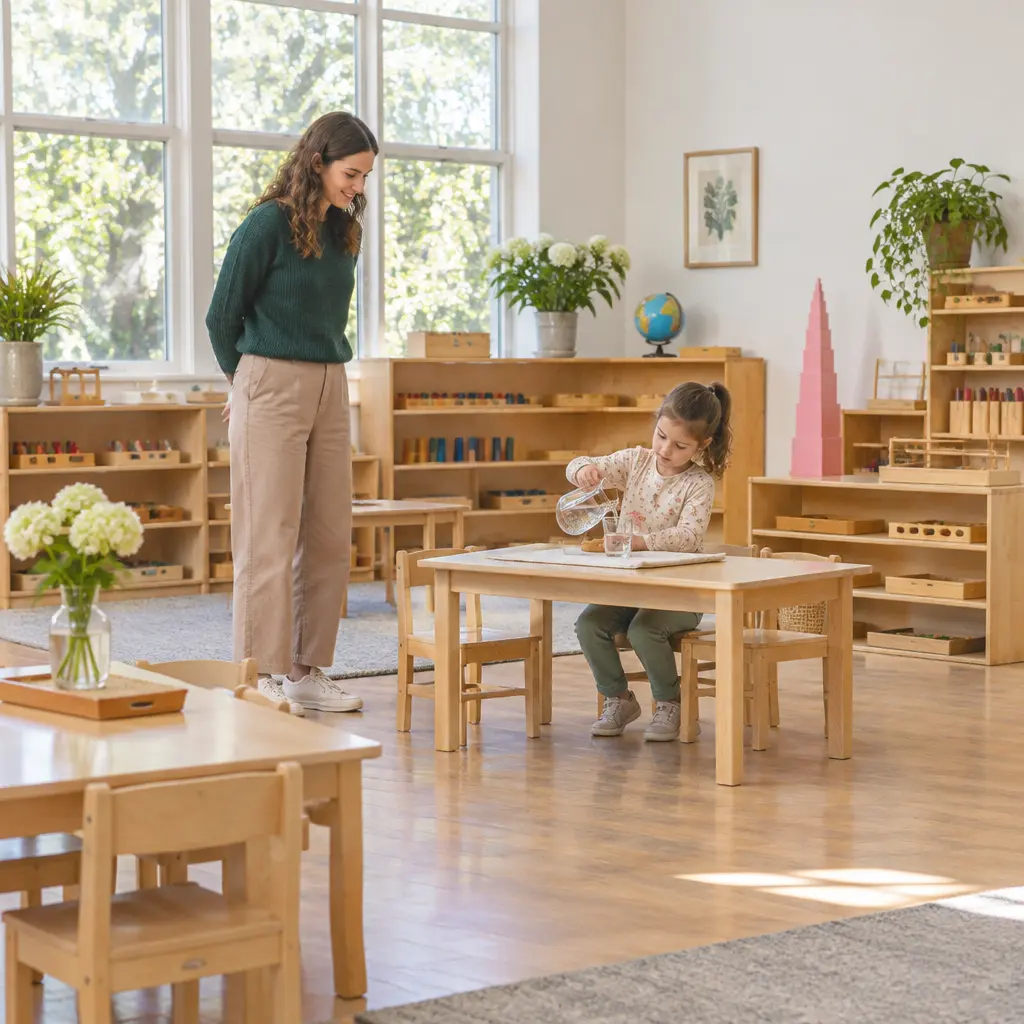
A prepared environment is an orderly, accessible classroom designed for children to choose and use materials independently. During a visit, look for child-sized furnishings, clearly arranged materials, sustained work periods, and children engaged in purposeful activity. Mixed-age classrooms are another common feature: they allow younger children to learn from older peers and older children to practice leadership, though age ranges and grouping practices vary by program.
Verify teacher training and credentials
Montessori teacher preparation is specialized training in the philosophy, curriculum, materials, and developmental needs of a particular age group. Ask which training organization issued each lead teacher’s credential, what age level it covers, and whether assistants receive Montessori-specific preparation. AMS and AMI offer school and educator recognition pathways, but accreditation or affiliation should be considered alongside direct evidence of classroom practice rather than as a substitute for it.
Check accreditation, licensing, and safety separately
Accreditation evaluates a school against a defined set of educational standards, while state licensing generally addresses legal requirements such as health, safety, and staffing. These are related but distinct forms of oversight. Ask for the school’s current status with relevant organizations, the applicable state license, and any recent inspection findings. A program may follow Montessori practices without holding a particular accreditation, so confirm what a credential means and what it does not establish.
Assess Montessori school teacher turnover and classroom continuity
Teacher turnover is the rate at which educators leave and must be replaced over a specified period. In Montessori settings, staffing continuity matters because children build relationships with teachers who observe their development, present lessons, and guide independent work over time. The National Center for Education Statistics tracks teacher attrition and mobility in U.S. schools, but national figures do not establish a particular Montessori school’s performance; families should request school-level data and ask how departures affect children.
Request clear, comparable staffing figures
Ask how many lead teachers and assistants left during each of the last three school years, how many positions were filled, and how the school calculates turnover. A raw departure count is difficult to interpret without the staff headcount, timeframe, and distinction between planned changes and vacancies. Also ask how long the current lead teacher has been at the school and whether the classroom has experienced repeated leadership changes.
Explore working conditions and retention practices
Compensation, benefits, planning time, professional development, classroom support, and leadership quality can influence whether teachers stay. The Learning Policy Institute has documented that teacher retention is shaped by working conditions as well as pay. Ask what mentoring and continuing Montessori training are available, how the school covers absences, and whether assistants have a path toward lead-teacher qualification.
Find out how the school supports children during transitions
A thoughtful transition plan can reduce disruption when a teacher leaves. Ask who communicates with families, how the incoming educator learns about each child’s progress, and whether another familiar adult remains in the classroom. High turnover does not automatically prove that a school is poor, but evasive answers, frequent unplanned vacancies, or a lack of transition procedures deserve closer scrutiny.
Use a consistent process to compare Montessori schools
Tuition, authenticity, and teacher stability are connected: a school’s financial model can affect staffing, while training and retention influence how Montessori principles are implemented. A comparison chart can make differences visible. List each school’s total annual cost, teacher credentials, classroom features, accreditation or affiliation, turnover figures, and answers about family communication; then compare like with like.
Questions to ask during a school visit
- What is the full annual cost, including required fees and care outside the school day?
- Which Montessori training do lead teachers hold for my child’s age group?
- Can I observe a typical classroom work period?
- How are children grouped by age, and how long do they remain with the same teacher?
- How many teachers have left in the past three years, and how is turnover calculated?
- What is the school’s current accreditation, affiliation, and state licensing status?
- How does the school support children when a teacher or assistant leaves?
Weigh evidence rather than relying on labels
A strong choice is supported by consistent evidence: transparent fees, prepared classrooms, relevant teacher training, appropriate oversight, and straightforward answers about staffing. One credential, a polished tour, or a low tuition figure cannot answer every question. Visit more than once when possible, speak with current families, and review written policies before making a commitment.
Conclusion: Choose a Montessori school with transparent costs and consistent practice
Choosing a Montessori school means evaluating the full cost of attendance, verifying that classroom practice reflects Montessori principles, and understanding whether teacher turnover affects continuity. National education statistics provide useful context, but school-level evidence is essential for comparing individual programs. Request itemized tuition and staffing data, verify credentials and oversight, observe a classroom, and ask how the school supports children through transitions. These steps help families make a choice that is educationally credible, financially sustainable, and responsive to their child’s needs.
Sources: American Montessori Society, Montessori Education, https://amshq.org/About-Montessori/What-Is-Montessori; Association Montessori Internationale, Montessori Approach, https://montessori-ami.org/about-montessori/montessori-approach; National Center for Education Statistics, Private School Universe Survey, https://nces.ed.gov/surveys/pss/; National Center for Education Statistics, Teacher Attrition and Mobility, https://nces.ed.gov/programs/coe/indicator/slb; Learning Policy Institute, Understanding Teacher Retention, https://learningpolicyinstitute.org/product/understanding-teacher-retention-brief
Related Posts

Feeling Lost About Becoming an Educator How Montessori Teacher Training Guides Your Career Path
Montessori Teacher Training as a Career Guide for Aspiring Educators…

Montessori vs Traditional Education Myths Parents Hear Before Visiting Any Classroom
Montessori education is a child-centered approach in which learners have…
Montessori Teaching Methods for Teachers Who Find Waiting to Intervene Difficult
Montessori teaching methods help teachers support children’s independence by observing…