
Montessori education is a child-centered approach in which learners have structured choices, use hands-on materials, and work at their own pace within a prepared classroom; traditional education commonly refers to teacher-directed instruction organized around whole-class lessons and a planned curriculum. Neither label guarantees a particular classroom experience or outcome. Research suggests Montessori can support some academic and social-emotional outcomes, but results depend on the school, implementation, and child—not on a slogan. Before visiting, it helps to separate common myths from what the evidence says about teacher roles, structure, academics, socialization, and fit.
Montessori education: what the approach means in practice
The American Montessori Society describes Montessori as an educational approach grounded in self-directed activity, hands-on learning, and collaborative play. Maria Montessori developed the method in the early 20th century, and its classrooms typically combine a prepared environment, specially designed learning materials, and educators who observe and guide rather than lead every activity from the front.
“Traditional education” is not one uniform model. It may describe classrooms with more whole-group teaching, teacher-selected tasks, age-based classes, and common schedules, but schools vary substantially. The meaningful comparison is therefore not Montessori versus an imagined opposite; it is the actual classroom’s curriculum, teaching, assessment, and support for children.
Prepared environments and purposeful choice
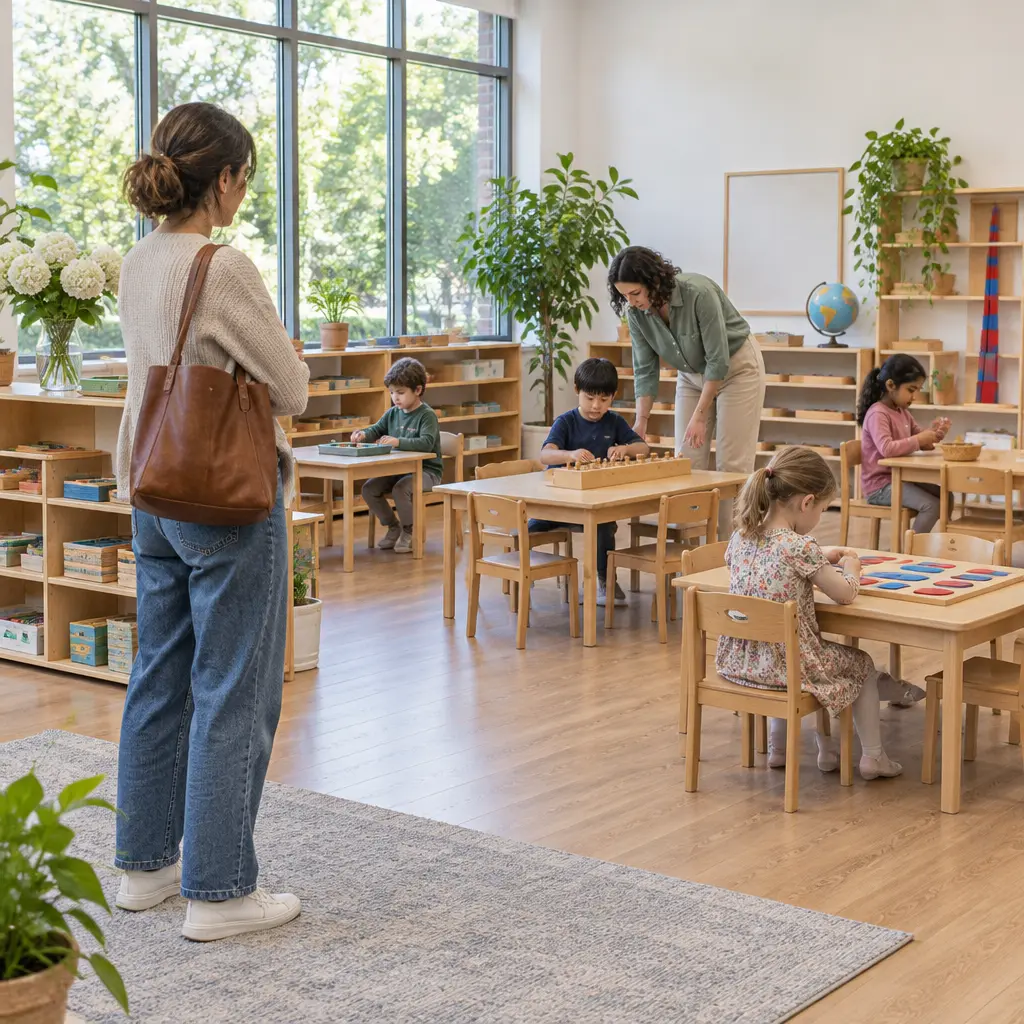
A prepared environment is a deliberately arranged classroom where materials are accessible, activities have an intended sequence, and children are expected to care for the space. Choice does not mean that every activity is available at all times or that children can opt out of learning. Teachers introduce materials, observe progress, and redirect children when needed.
Mixed-age groups and developmental progression
Many Montessori programs group children across a multi-year age span, such as ages three to six. This can give younger pupils opportunities to learn by watching older classmates, while older pupils practice explaining and helping. Mixed-age grouping is a design feature, not proof by itself that a classroom is high quality; relationships, instruction, and classroom management still matter.
Materials, lessons, and teacher guidance
Montessori materials are often designed to make a concept concrete and, in some cases, allow children to notice an error themselves. Teachers provide individual or small-group lessons and monitor whether a child is ready for more complexity. Traditional classrooms also use hands-on materials and differentiated instruction, so the distinction is usually one of emphasis and organization rather than an absolute divide.
Montessori education myths about structure and teacher roles
The most persistent misconceptions treat Montessori as either a classroom without rules or a classroom where teachers do little. In practice, the approach substitutes a different kind of structure: clear routines, limits on how materials are used, and sustained work periods, alongside student choice.
Myth: Montessori means children do whatever they want
Reality: Children make choices within boundaries set by the teacher and the classroom. A pupil may choose among lessons they have been shown, but the teacher can intervene if an activity is unsafe, disruptive, or not developmentally appropriate. During a visit, ask how educators respond when a child avoids a subject or repeatedly chooses the same work.
Myth: Montessori teachers do not teach
Reality: Teachers teach through demonstrations, observation, targeted lessons, and careful preparation of the environment. Their instruction may be less visible as a whole-class lecture, but it is not absent. The National Center for Montessori in the Public Sector emphasizes that Montessori educators guide learning while tracking each child’s development and introducing new work when appropriate.
Myth: Traditional classrooms have no choice or independence
Reality: Many conventional schools include projects, learning centers, student discussion, and independent work. Conversely, Montessori classrooms have shared expectations and teacher-assigned lessons. Ask what choices students actually make, how much time they spend on independent work, and how teachers balance individual goals with required curriculum.
Montessori education myths about academics and outcomes
Parents often hear that Montessori is either academically lax or guaranteed to produce exceptional results. Neither claim is justified by the evidence. Outcomes vary across programs and studies, and a school’s implementation and student population affect what comparisons can tell us.
Myth: Montessori children do not learn core academics
Reality: Montessori programs generally teach literacy, mathematics, science, and other academic areas, often using a progression from concrete experiences to more abstract ideas. The sequence and presentation may look different from a conventional workbook-led lesson. Ask how the school maps its curriculum to state or national standards and how it identifies children who need additional support.
Myth: Montessori guarantees higher test scores
Reality: Research is encouraging in some areas but does not establish a universal advantage for every child or school. A 2017 randomized controlled study by Angeline Lillard and colleagues, published in the journal Frontiers in Psychology, followed children offered admission to a public Montessori school through a lottery. It reported gains in some academic and social outcomes over the study period. Because it examined a particular program and population, it should not be treated as a prediction for every Montessori classroom.
A 2023 systematic review and meta-analysis by Randye Semmes and colleagues in Campbell Systematic Reviews found positive average effects across several academic and nonacademic outcomes, while also noting variation among studies and limitations in the available evidence. Such findings support careful consideration, not guarantees. A useful chart for comparing schools would track curriculum coverage, student progress, attendance, and classroom observations—not test scores alone.
Myth: Montessori is less accountable because children work at their own pace
Reality: Individual pacing still requires assessment. Teachers can use observation, work records, conferences, and formal assessments to check progress. The key question is whether the school can clearly explain how it monitors learning, communicates concerns, and adjusts instruction when a child is behind or ready to advance.
Montessori education myths about social development and classroom fit
Questions about friendship, collaboration, and a child’s temperament are best answered by observing children in the specific school. The method’s ideals do not remove the importance of peer relationships, inclusion, or individualized support.
Myth: Montessori children work alone and miss out on socialization
Reality: Montessori classrooms include individual work as well as peer interaction, shared activities, and opportunities for children to help one another. Mixed-age settings may create different social roles than same-age classrooms, but no arrangement guarantees strong social skills. Observe how children negotiate turns, collaborate, resolve disagreements, and include classmates.
Myth: Montessori only suits quiet, highly independent children
Reality: Children with varied personalities can thrive in different settings. A child who benefits from frequent adult direction may need a school that provides more explicit structure; a child who enjoys extended independent work may appreciate Montessori’s work periods. These are questions of fit and support, not fixed categories of children. Ask how teachers support attention, transitions, language development, disability accommodations, and social-emotional needs.
Myth: Montessori schools are all alike—and all are costly
Reality: Montessori schools differ in teacher training, fidelity to the method, schedules, tuition, and public or private status. The National Center for Montessori in the Public Sector documents public Montessori programs, showing that Montessori is not limited to private tuition-based schools. Families should verify the school’s credentials and ask what Montessori training its lead teachers have completed, rather than relying on the label alone.
How to compare Montessori and traditional classrooms during a visit
A classroom visit turns broad claims into observable questions. The National Center for Education Statistics reported that U.S. public schools enrolled about 49.6 million students in fall 2022, illustrating the scale and diversity of the wider school system; that figure does not indicate which teaching approach is best. Parents can make a more useful comparison by examining the daily experience their child would actually have.
- Ask how the curriculum covers reading, mathematics, science, and required standards.
- Find out how teachers assess progress and communicate it to families.
- Observe whether children are engaged, whether adults respond warmly, and whether expectations are clear.
- Ask how the school supports children who need extra help, enrichment, or accommodations.
- Compare class size, staff qualifications, daily schedule, costs, and available services.
- Request a sample daily routine and examples of student work or progress reports.
For example, a family comparing a Montessori program with a nearby conventional school might ask both schools how a child learns phonics, how teachers notice reading difficulties, and what happens when a student finishes work early. The answers reveal more than the label: they show the school’s instructional sequence, assessment practices, and responsiveness.
Conclusion: replace education myths with classroom evidence
Montessori education is a structured, child-centered approach—not a free-for-all, a promise of higher test scores, or a method that excludes teacher instruction. Traditional education is also diverse and can include independence, hands-on learning, and individualized support. Research finds promising average outcomes for Montessori in some studies, but neither approach guarantees a particular result for an individual child.
When choosing a school, focus on the prepared environment, teacher guidance, academic progression, social climate, assessment, and fit for your child. Visit more than one classroom, ask specific questions, and request evidence of how the school supports learning. The best next step is not to decide from a myth, but to compare what children and teachers actually do each day.
Sources: American Montessori Society, “What Is Montessori Education?”, https://amshq.org/About-Montessori/What-Is-Montessori; National Center for Montessori in the Public Sector, “Montessori Census,” https://www.public-montessori.org/montessori-census/; Angeline S. Lillard et al., “Montessori Preschool Elevates and Equalizes Child Outcomes: A Longitudinal Study,” Frontiers in Psychology, 2017, https://doi.org/10.3389/fpsyg.2017.01783; Randye Semmes et al., “The Impact of Montessori Education on Academic and Nonacademic Outcomes: A Systematic Review,” Campbell Systematic Reviews, 2023, https://doi.org/10.1002/cl2.1330; National Center for Education Statistics, “Enrollment Trends,” https://nces.ed.gov/programs/coe/indicator/cga.
Related Posts

Common Mistakes to Avoid When Understanding the Montessori Early Childhood Curriculum
Understanding Montessori Early Childhood Curriculum: Definitional Clarity and Common Pitfalls…

Struggling with Math Anxiety How Montessori Math Education Builds Confidence from the Start
Math Anxiety and Montessori Math Education Math anxiety is a…
Choosing a Montessori School Questions About Tuition, Authenticity, and Teacher Turnover
Montessori school choice comes down to more than a school’s…